



Plinko Strategy Without the Bull: A Plain-Talk Guide for Canadian Players
Developer:
Hacksaw Gaming / Stake
Slot Type:
Instant
Payout Variance:
Adjustable
Return Rate:
95–99%
Minimum Stake:
1
Maximum Bet:
100
Auto Spin:
Yeah
Released On:
01.01.2020
Plinko is fun. Plinko is also a game with a built-in house edge, which means players lose money in the long run. Both of those things are true at the same time, and any guide that pretends otherwise is selling something. This guide explains what's actually going on under the hood — the math, the risk levels, the bankroll choices, the betting systems people swear by — and is honest about what works and what doesn't. The goal here is to help players play smarter, not to promise winnings that aren't coming. Players must be 19+ in most provinces (18+ in Quebec, Manitoba, Alberta). For support, ConnexOntario answers 24/7 at 1-866-531-2600.
How the Math Behind Plinko Actually Works
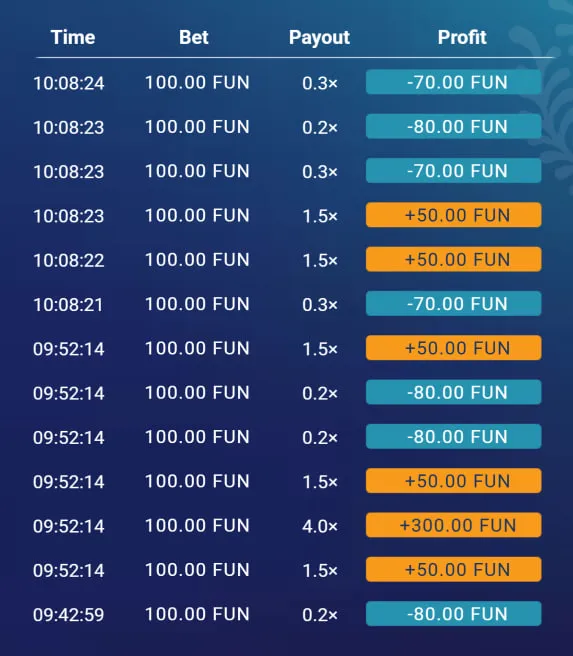
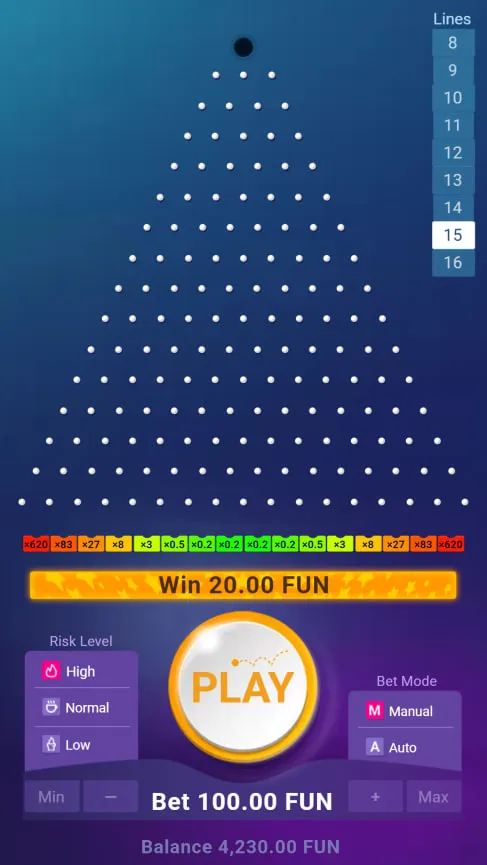
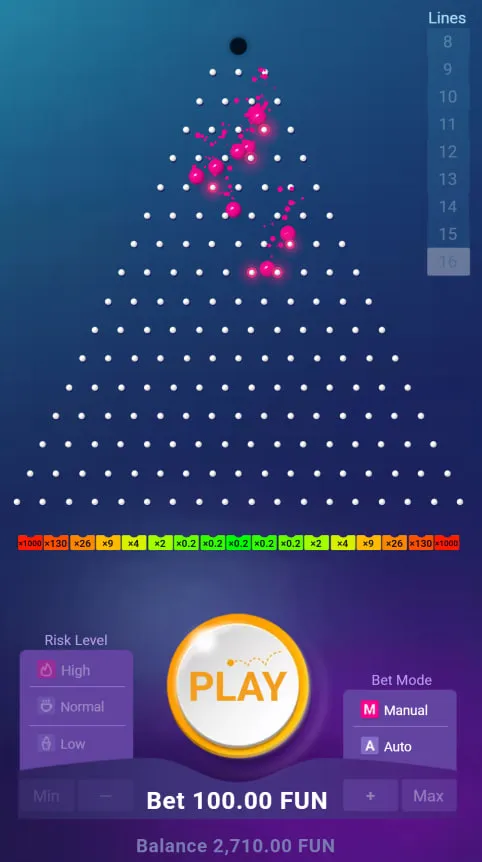
Picture the board. A ball drops in at the top, hits a peg, and bounces left or right. Then it hits another peg and does the same thing. Sixteen rows of pegs later, the ball lands in one of seventeen slots at the bottom. Each peg flips a coin: 50/50, left or right. So where does the ball end up? That's a binomial distribution.
The probability the ball lands in slot k after sixteen rows is C(16, k) divided by 65,536. Slot 0 (the leftmost edge): 1 in 65,536, which is 0.0015%. Slot 8 (dead center): 12,870 in 65,536, which is 19.6%. The shape that comes out of these probabilities is a bell curve — most balls land near the middle, very few make it to the edges. That's why the casino can pay 1,000× on edge slots and still come out ahead: almost nobody hits them.
If you've seen Pascal's Triangle — that triangle of numbers where each entry is the sum of the two above it — you've already seen Plinko's probability map. The numbers in row 16 of Pascal's Triangle are exactly the binomial coefficients above. For 8 rows, Pascal's Triangle hands you 1, 8, 28, 56, 70, 56, 28, 8, 1 (which sum to 256). That's why 70/256 = 27.3% of 8-row balls land in the center: the math is baked into a triangle that mathematicians have known about for centuries. As the row count grows, the bell-curve shape gets smoother and approaches what statisticians call a normal distribution — the same curve that shows up in heights, test scores, and pretty much every measurement of independent random events stacked together.
Expected value (EV) is just the probability of each slot times its multiplier, all summed up. For BGaming and Stake Originals, that sum equals 0.99 — the published 99% RTP. Hacksaw Gaming sums to 0.9898; Spribe sums to 0.97. The 1–3% gap between those numbers and 100% is the house edge. It's small per spin and inevitable across many spins.
| Slot | Probability (16 rows) | BGaming Medium-Risk Multiplier |
| 0 / 16 (edge) | 0.0015% | 110× |
| 2 / 14 | 0.18% | 14× |
| 5 / 11 | 6.7% | 2× |
| 7 / 9 | 17.5% | 1.0× |
| 8 (center) | 19.6% | 0.5× |
Risk Levels: What "Low," "Medium," and "High" Really Mean
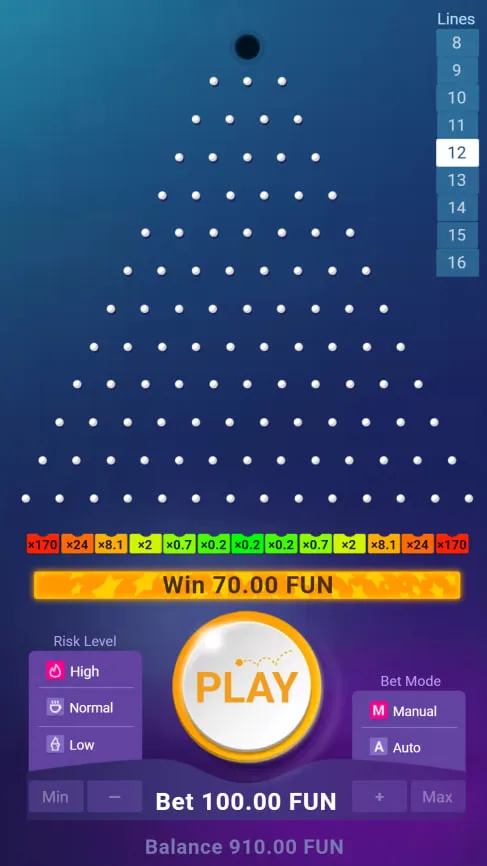
BGaming, Hacksaw, and Stake all let players pick a risk level. Here's the part most players miss: changing risk level does not change RTP. All three risk settings pay back the same percentage over time. What changes is the volatility — how spread out the wins and losses are.
Volatility is just a word for how much a game's outcomes bounce around. Low volatility (low risk) gives you small, frequent results. High volatility (high risk) gives you big, rare results. Same long-run return either way, totally different ride. Mathematicians use "variance" for the same idea — variance is volatility squared, which makes it useful for math but harder to talk about casually.
Low risk: multipliers run from about 0.5× up to 5× or 15×. Center losses are mild, edge wins are modest. The result is a smooth ride — small ups and downs, not many surprises. High risk: center multipliers drop as low as 0.2×, but edge multipliers climb to 1,000× (BGaming, Stake) or 3,843× (Hacksaw). Most spins lose more than they pay, then occasionally one spin wipes out the bankroll's losses in a single hit. Or doesn't — that's variance.
Practically, this means high risk needs a bigger bankroll than low risk to survive the same number of spins. Players running high risk with C$50 in the account will usually be broke faster than they expect.
Which Risk Level to Pick
If you just want to play and have fun, low or medium risk on 8–12 rows is the sane choice. If you specifically want to chase the rare big multiplier and you've got the bankroll to ride out long dry spells, high risk on 16 rows is what you're after.
Rows and Pins: Why the Number of Plinko Rows Matters
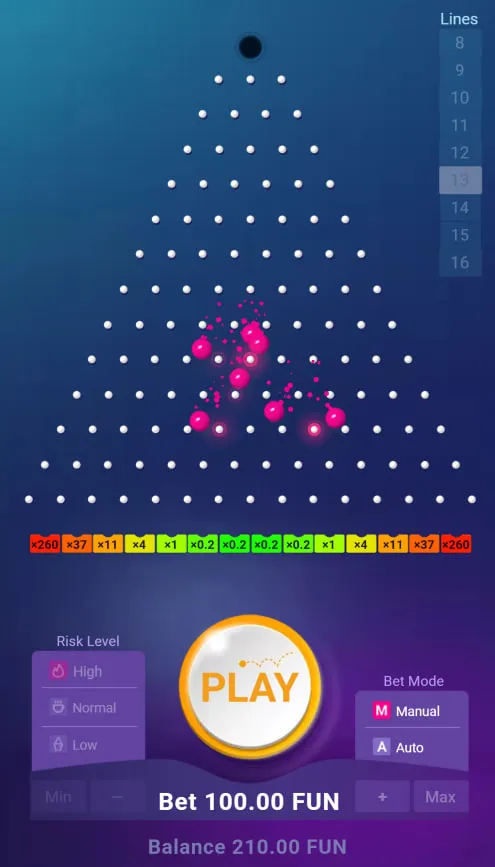
Most online Plinko lets players pick 8, 12, 14, or 16 rows — what's collectively called Plinko Rows or board height. More Plinko Rows means a wider multiplier range and a sharper bell curve — center hits get more common, edge hits get rarer. An 8 Rows board has a 27.3% chance of landing in the center slot. A 16 Rows board drops that to 19.6%, but the edge probabilities collapse to nearly nothing. The 8 Rows configuration is the friendliest entry point for casual play; 16 Rows is for variance hunters with bankroll to back it up.
| Rows | Outcomes | Center Probability | Edge Probability | Best For |
| 8 | 9 | 27.3% | 0.39% | Casual play |
| 12 | 13 | 22.6% | 0.024% | A balanced game |
| 16 | 17 | 19.6% | 0.0015% | Variance hunting |
Bankroll: The Only Strategy That Actually Helps
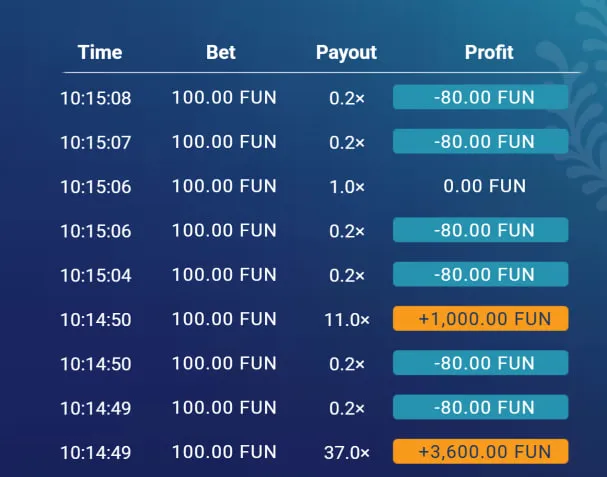
This is the part of the guide that actually matters. Bankroll discipline is the single thing a Plinko player controls that affects how long the bankroll lasts. The math works whether anyone likes it or not.
Recommended bet size: 0.5–2% of the bankroll per spin at low risk. 0.1–0.5% at high risk. With a C$200 bankroll and a C$1 bet at 99% RTP, a player can expect somewhere around 19,800 spins before going broke — though the actual number bounces around quite a bit thanks to variance. A stop-loss of 30–50% of session bankroll keeps a bad session from becoming a worse one. A win goal of 50–100% means walking away when ahead. Sessions of 30–60 minutes are easier to stay sharp through.
| Bankroll | Risk | Recommended Bet | Expected Spins | Stop-Loss | Win Goal |
| C$100 | Low | C$0.50 | ~9,900 | C$30 | C$50 |
| C$500 | Medium | C$2.50 | ~9,900 | C$200 | C$300 |
| C$1,000 | High | C$2.00 | ~24,500 | C$400 | C$700 |
Important honesty break: none of these bankroll rules turn Plinko into a profitable game. They're survival rules, not winning rules. They make a session last longer and keep losses smaller. That's it.
Betting Systems: What Actually Works (and What Doesn't)
Martingale
The classic. Double the bet after every loss, theory being that one win covers everything. The problem is real: casinos cap bets, and bankrolls run out. C$1 doubled across eight losses needs C$256 on the ninth round, with C$255 already gone. On high-risk Plinko, eight straight losses (judged against a 1× threshold) happen often enough to bust normal bankrolls.
Fibonacci
Bet sizes follow 1, 1, 2, 3, 5, 8, 13... Slower escalation than Martingale, longer survival, same fundamental problem on bad streaks. EV stays negative.
Flat Betting
Same bet every time. Sounds boring. Mathematically, it's the safest approach — minimizes risk of ruin per unit time. The recommended default for almost everyone.
Reverse Martingale (Anti-Martingale)
Double after wins instead of losses. Locks in profit during streaks; max loss is just the starting bet. Variance is bounded, but EV is still negative.
Paroli
A three-step win progression: bet up after the first win, up again after the second, then reset. Limited downside, structured upside. Doesn't change long-run RTP either.
The plain truth: betting systems just rearrange when wins and losses happen. They never change the underlying math. Flat betting is what the smart money does, even though it's the least exciting.
"Guaranteed Win" Plinko Strategies Are Scams. Always.
This section won't be polite about it. There's a whole industry built on selling fake Plinko strategies, and players need to know what it looks like.
Predictor apps and Telegram bots claim to predict the next ball's path. They can't. Provably Fair cryptography makes that mathematically impossible — the result is fixed before the player even places the bet, locked into a hash. Paid VIP strategy courses sell "insider knowledge." There is no insider knowledge. Casinos use RNGs audited by eCOGRA and iTech Labs; nobody has secret access. Hacked-RTP claims are also fake. The published RTP is baked into the certified game logic.
Red flags to watch for: anyone asking for payment to access a "secret"; testimonials with no audit; claims of 100% or guaranteed wins; pressure to buy "right now"; unlicensed operators not on regulator whitelists. If a player encounters a scam, the AGCO complaint form (Ontario) and the Canadian Anti-Fraud Centre at 1-888-495-8501 are the right channels.
RTP Optimization: Pick the Right Plinko Variation
Within a single Plinko title, settings (risk and rows) don't change RTP. Across titles and Plinko Variations, RTP varies. The picture: Stake Originals and BGaming both publish 99%. Hacksaw Gaming publishes 98.98%. Spribe publishes 97%. Hybrid Plinko Variations (plinko hilo, plinko ladder variant, mines-Plinko fusions) often run lower at 96–98%. For maximum theoretical return, classic Plinko at BGaming or Stake is the answer.
Each Plinko Variations type comes with its own quirks. Plinko Hilo bolts a high-low card guess onto the drop, which adds a second decision and usually drops RTP a percentage point. Plinko ladder variants stack a vertical multiplier escalator on top of the regular drop. Mines-Plinko fusion games sprinkle hazards onto the board — bigger top wins but a real chance the bet is gone before the ball reaches the bottom. For a player who just wants to drop a ball at maximum honest RTP, classic Plinko on BGaming or Stake is the answer; the Plinko Variations are fun but cost a percentage or two.
Provably Fair: How to Check the Math Yourself
Provably Fair is a cryptographic system that lets a player verify the casino didn't tamper with a spin's outcome. Five steps:
- Before the spin, the casino shows you a SHA-256 hash of its server seed. (The seed itself stays hidden.)
- You provide your own client seed (random or whatever you choose).
- You spin. The casino reveals the original server seed.
- You compute the SHA-256 hash of that revealed seed and compare it to the hash you got before the spin. If they match, the seed wasn't swapped.
- You run the combined seed through the documented game algorithm and confirm the output matches what you saw.
BGaming, Stake Originals, and Hacksaw Gaming all implement this. The verifier is usually built right into the casino's interface, so most players don't need anything else. Independent third-party verifiers exist for those who want to use them.
The Most Important Strategy: Knowing When to Stop
Of everything in this guide, this section matters most. The single most powerful tool a Plinko player has is setting deposit limits, loss limits, and time limits at signup — before any session, while making decisions that will outlast the session. Deposit limits cap how much you can transfer in. Loss limits — separate from deposit limits — cap how much you can be down before the casino cuts you off. Time limits cap how long the session can run. Reality check pop-ups every 30 or 60 minutes interrupt extended play. Self-exclusion ranges from 24-hour cooling off to permanent account closure. Ontario casinos take part in the GameSense framework. ConnexOntario answers 24/7 at 1-866-531-2600. The Responsible Gambling Council (RGC) is at 416-499-9800 — RGC also runs the GameSense program with provincial operators. CAMH supports problem gambling at 416-535-8501.
None of the strategies in this guide make Plinko profitable. They help players play with discipline. The most important strategy is knowing when to stop.
Frequently Asked Questions
Is there a guaranteed Plinko strategy?
No. Plinko has a built-in 1–3% house edge. No betting strategy beats negative expected value over the long run. Anyone selling guaranteed wins is running a scam.
What's the best risk level?
Depends what the player wants. Low risk preserves bankroll and gives consistent play. High risk targets rare big multipliers but burns through bankroll faster. Medium balances both. RTP is identical at all three.
Does Martingale work on Plinko?
No. Martingale fails because compound losses plus table bet caps create realistic bust scenarios in 7–9 consecutive losses. On high-risk Plinko, those streaks happen often enough to matter.
How do I verify Plinko is actually fair?
Provably Fair verification. The casino pre-commits a SHA-256 hash; after the spin, the player can verify that hash matches the revealed seed, and that the combined seed produced the observed result through the game algorithm. Most casinos provide a built-in verifier.